Integrating Subcontractor Data into an Integrated Master Schedule

, , , , , , ,

Generating and maintaining a project’s Integrated Master Schedule (IMS) that meets management needs as well as customer requirements is difficult under the best of circumstances. The challenge becomes even more complex when subcontractor work effort must be incorporated. Issuing a subcontract is, in effect, handing off a portion of the work scope to an outside entity that becomes responsible for performing that work and meeting all technical requirements. 

Another consideration for contractors where Earned Value Management System (EVMS) contractual requirements apply is whether the subcontractor is considered a major subcontractor because of the contract value, scope of work, or high risk factors. The EVMS requirements are flowed down to these major subcontractors; they will have the same contractual requirements and challenges as the prime contractor. Most subcontracts do not fall into this category. Many are small, short term, or firm fixed price (FFP) subcontracts. 

Regardless of the category of the subcontractor, the subcontractors and the prime contractor all need an IMS to plan and coordinate work effort as well to measure progress. Using FFP subcontracts on development projects has the potential to increase risk significantly when expectations for scheduling rigor are not clearly defined. 

A Real World Example

H&A EVM consultants supported a multi-billion dollar development project that illustrates the challenges with integrating subcontractor schedules into a prime’s IMS. The prime contractor had two major subcontractors with EVMS flow down requirements. They also had 22 FFP subcontracts without EVMS flow down requirements. 

These FFP subcontracts were also mission-critical. The prime’s first priority was to define the required schedule format and data content in the request for proposal (RFP) to the subcontractors. Standardization was essential, along with specific instructions to ensure the schedule data could easily be incorporated in the prime’s IMS. 

As the basis for a customized project specification, the team selected the Integrated Master Schedule (IMS) Data Item Description (DID) DI-MGMT-81650, an earlier DID that preceded the Integrated Program Management Report (IPMR) and Integrated Program Management Data and Analysis Report (IPMDAR) DIDs. The requirements were simplified and trimmed to selected sections in the DID for the detailed schedules. The document was assigned a specification number within the prime’s document management system so it could be used for future procurements. 

Early Schedule Submittals: A Wake-Up Call

All the subcontractors dutifully proposed and were awarded subcontracts. The FFP subcontractors were required to submit initial schedules using the scheduling tool of their choice at the end of the first month of performance. To ensure compliance, the prime contractor tied the subcontractor’s first payment milestone to the acceptance (receipt, review, and approval) of their first schedule. 

This turned out to be one of the best decisions made during project startup. 

Those first schedules quickly revealed that many of the lower tier subcontractors had no experience developing logic-driven schedules that could comply with the reduced requirements document. They were unable to generate even the most basic project schedule. It was an eye opener to realize that while the first tier companies and most of the second tier companies did know about project scheduling, some of the second tier and all of the lower tier companies lacked that expertise.

The Solution: A Prime-Led Schedule Development Workshop

The prime’s schedule team, largely comprised of H&A schedulers, quickly initiated a week long on-site workshop open to all subcontractors who wanted help building their IMS. Every one of them signed up as they recognized acceptance of their schedule was a prerequisite for payment. 

Prime contractor personnel were assigned to each subcontractor to help them build schedules that met the requirements. Most of the subcontractors were able to produce an acceptable schedule within the first three days. The other subcontractors required the full week.

The workshop approach provided two major benefits.

  1. The subcontractors gained experience in developing a logic-driven schedule that they could maintain and status. They had a better understanding of what the prime contractor expected them to provide. 

  2. The prime’s schedule team gained a better understanding of each subcontractor’s scope of work and execution strategy. They had a better picture of the entire IMS as well as interdependencies. Without this knowledge, the next step of determining the best strategy to incorporate the subcontractor’s schedule data into the prime’s IMS would have failed. 

Strategies for Incorporating Subcontractor Data into the Prime’s IMS

The NDIA Integrated Program Management Division (IPMD) Planning and Scheduling Excellence Guide (PASEG) is a useful source of information on scheduling best practices. The section on External Schedule Integration offers basic guidance on flowing down detailed scheduling requirements to subcontractors. It also provides a short list of things to consider, such as coordinating dates and change control:

“Status dates should be consistent between the prime contractor and supplier schedules. If the subcontractor’s schedule update is to a different point in time, it could potentially affect the IMS analysis results. If it is not possible to have consistent status dates between the various schedule elements then implement a strict process, with support of all parties, to manage the impacts.

Change control procedures are established and understood. The prime contractor should clearly communicate which type of schedule changes will require pre-approval before incorporation and which type will require coordination only or documentation upon submittal. The lack of a disciplined change control process can result in disconnects between the prime contractor and subcontractor’s schedule.”

Remember the prime contractor’s IMS includes a baseline and a current schedule. The complications can be significant when all the variables are considered such as calendars, mix of schedule tools and options, scheduling techniques, resource loading, and custom fields.

That still leaves the question of how to incorporate the schedule data from an external source into the prime’s IMS. The PASEG outlines three approaches.

  1. Full integration where the entire subcontract schedule is incorporated into the prime’s IMS. 

    Pros: Provides maximum visibility into the critical and driving paths as well as forecast completion dates.

    Cons: Often not feasible with a large number of subcontractors. Mix of scheduling tools complicates the process. 

    Use Notes: This option is often reserved for major subcontractors or teaming partners. Works best when the prime and subcontractor are using a common scheduling tool or the subcontractor has direct access to the prime’s IMS scheduling tool to maintain their data. Otherwise, the prime must incorporate additional processes to import the external data into their IMS. There are other complications, as different schedule tools calculate dates differently, that will need to be handled in the integration process. 

  2. Using interface milestones. 

    Pros: Easier to implement and maintain. Yields the best results with less complex or lower risk subcontractors. 

    Cons: Provides less insight into the subcontractor’s current schedule performance. It does not easily support critical path analysis when paths run through subcontract work effort.

    Use Notes: Requires the manual update of each interface milestone to reflect the latest forecasted dates from the subcontractor’s schedule. The prime must ensure their IMS is properly coded. Contractors often use “External Inbound” and External Outbound” codes along with a subcontractor code and any other codes needed to identify who is receiving/giving to whom.

  3. Representative model. This is a middle ground approach between integrating the entire subcontractor’s schedule into the prime’s IMS and using interface milestones. Requires a summarization or representation of the subcontractor’s work to be entered into the prime’s IMS.

    Pros: Provides a summarized version of the subcontractor work effort that retains enough schedule logic for critical and driving path analysis. 

    Cons: IMS content must be carefully entered and maintained to retain the required relationships to the external schedules for accurate critical path analysis. Requires a higher level of schedule discipline and a defined process to ensure the accuracy of the data between the external schedules and the prime’s IMS. 

    Use Notes: It is often beneficial to provide the subcontractor with a copy of their schedule that includes an extra column that identifies the prime’s task ID that is the “parent” of the summarized or consolidated work. In the initial IMS submission from the subcontractor, the prime added a custom field (Prime Parent ID). That IMS file was returned to the subcontractor, and the use of the special field was agreed upon. In each subsequent submission by the subcontractor, the prime team checked for tasks with no “Prime Parent ID” and added one that would allow integration. This kept the two companies’ schedules synchronized. If changes were made by the prime team that changed the field data in the subcontractor’s IMS, the changes were coordinated. A recommended practice is to group and sort the subcontractor schedule by the prime’s IDs to ensure that it is done properly. 

What Worked for the Complex Development Project

In the situation described earlier, the schedule team determined a hybrid approach was the best solution, depending upon the subcontractor’s scope of work.

  • The full integration approach was quickly eliminated; it was impractical. There were too many schedules, and some were too complex. It would have been a logistical nightmare. 
  • Selected simple FFP subcontract work effort was incorporated using the milestone method. The schedule milestones were carefully aligned to the payment plan milestones so that one set of milestones served both purposes.
  • For the subcontracts with EVMS flow down requirements and the other subcontracts, including some FFP subcontracts, the representative model was used. The prime’s control account manager (CAM), responsible for the subcontractor’s scope of work, was required to condense the subcontract schedule into a representative model that made sense to the CAM. The most common ratio turned out to the 10:1, with 10 subcontractor tasks rolling up to 1 prime contractor IMS task, carefully maintaining the prime’s control account and work package structure. With proper coding, the subcontractor schedule could be easily reviewed and analyzed by the CAM as well as other project personnel.

Need help establishing strategies to integrate subcontractor schedule data?

Every project presents unique scheduling challenges, and the approach for integrating subcontractor data often needs to be tailored to fit the situation. H&A earned value consultants and master schedulers have seen and solved them all. With deep experience across diverse industries and project types, our experts deliver the insight and leadership needed to help contractors implement practical, results-driven solutions for integrating subcontractor data. Call us today to get started.  

Integrating Subcontractor Data into an Integrated Master Schedule Read Post »

Survey of Schedule Acceleration Techniques

, , , , , , ,
Survey of 
Schedule Acceleration Techniques - An overview of schedule acceleration techniques discussed in the PASEG

The NDIA Integrated Program Management Division (IPMD) Planning and Scheduling Excellence Guide (PASEG) includes a list of the acceleration techniques that can be applied to reduce project schedule duration. That section of the guide provides the background for project team discussions on accelerating complex integrated master schedules (IMS) in government contracting environments. This blog is intended to increase awareness of the techniques in the guide and provide some additional insight into their application. It relies heavily on the guide’s content. 

An additional purpose of this blog is to promote the use of the NDIA IPMD nomenclature across the defense industry spectrum. In much the same way as the earned value management (EVM) acronyms of BCWS, BCWP, ACWP and others have become standard terminology, it would be beneficial to have a more standard way of discussing schedule acceleration techniques. As the PASEG is an industry guide developed and maintained in collaboration with U.S Government agencies, the PASEG promotes a common understanding of these techniques.

One caution. Modifications like the ones discussed here can introduce additional risk into the schedule and reduces flexibility. Be careful when modifying the schedule. A good practice is to first create a copy of the schedule and assess the effects of your changes before you adopt them. The trade-offs may or may not be acceptable depending upon the objective you want to achieve. If the schedule is the priority, there is likely to be an impact on the work scope or cost. There can also be unintended consequences when potential impacts are overlooked. 

Let’s review the techniques from the PASEG. 

  1. Crashing. 

The guide says “This technique allows for the acceleration of schedule by applying additional resources or more experienced resources to do the work in a shorter period of time. This method assumes that the task can be completed in a shorter amount of time with the increase in resources.”

We probably have all used this method when we are shopping on the internet and we are faced with the choice between receiving the item in 5 days or accelerating that to 3 days or even the next day. We are paying more to get it faster. But what is really happening behind the scenes? Do they pick your order first? Do they pack it first? Do they ship it on faster carrier? Those are the actions you would be considering on your project when you want to accelerate something by crashing the schedule.

Using outside or contract labor is a form of this where we boost our workforce for a period when we need extra effort. A form of this is offloading some work to a subcontractor.

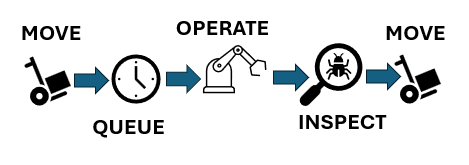
A more detailed example comes from the factory setting where certain orders are “expedited”. What that might mean is that the normal movement process is subverted. The normal process might be as shown in Figure 1 with a queue time while your order waits for the machine. The machine will be torn down and set up for your work when it is most efficient to do so.

Process with wait time
Figure 1: Process with wait time

When you crash this process, you might simply remove the queue time so that as soon as your order arrives the machine is torn down and set up for your job to eliminate the wait time as shown in Figure 2.

Process with wait time eliminated
Figure 2: Process with wait time eliminated

However, using this approach is likely to increase cost and has the potential to introduce other risks to the project. A real-world example comes from the semiconductor industry where the factory was running both standard products and custom products. A normal custom order time of 8 weeks was cut to 2 weeks by using this approach. The cost that was charged to the customer for the rushed custom order was about 10 times the normal cost of an order to repay the factory for lost efficiency. 

  1. Fast-tracking.

The guide tells us “This technique accelerates the plan by performing work in parallel. With this method, extra attention needs to be put on resource de-confliction to ensure resources are not over allocated.”

We have all used this technique and probably had mixed outcomes. It seems simple and attractive. It embodies a “just get it done” mentality. If there are sufficient trained and capable resources then this can work. The resources can be used on both efforts at the same time. If that is not the case, then basically we would have to revert to pushing effort out of the way for another effort. This type of modification can introduce additional risk that may need to be mitigated.

  1. Streamlining.

The guide defines this technique in this way: “This technique depends on the team’s ability to find an alternate and more efficient completion methodology for the task/s. This includes reuse, innovation, and possibly eliminating non-value-added work. With this method, the program has to weigh the level of potential risk involved with these choices. Make sure that this does not drive a “run to fail” mode on the program. Ensure that tasks are meeting the full requirements and scope.”

Here we really need to be careful. In some cases, we might be working with specifications or requirements that demand a certain approach and cannot be changed or waived. Then we need to ask the question, “If there is a better way, why didn’t we assume that in the first place?”

In some cases, we might find this approach fits in with opportunity management. Maybe there is new software or a new machine available that can speed things up and still get things done correctly. We have all been in that situation; just remember the last time you went through a Windows upgrade. Did that go smoothly for you? 

In the area of software in particular, we must be aware of the entire ecosystem of tools we use and consider that any new tool applied in a hurry can result in problems. Case in point: one large contractor shifted from 2D drawings to 3D models to speed up and improve the processes, however not all the key suppliers were able to receive and use 3D models. The supply chain broke. Mom and Pop at the M&P Shop could not understand the new work orders. 

  1. Focused Work.

The guide describes focused work like this: “This technique employs the program management team to help in reducing multitasking and to remove barriers for the personnel on the program that are working critical and near critical program tasks. This method requires the program culture to adapt and “protect the critical/driving path” and to support the people that are working those efforts. This also requires the program manager to perform daily barrier resolution.”

A discussion on multi-tasking might be fun here, but we will assume for this blog that multi-tasking pulls resources away from tasks to do other selected tasks and that is not always the best approach. The big question here is what happens to the other efforts on the project when we focus on certain tasks. This technique can work well but only if we are aware of the impact to the other work and manage that work as well. Risk can be increased by adopting this approach so be alert. If we really are just removing barriers then we can benefit from this method. If we are just pushing aside other efforts to concentrate on this one, we need to know that and handle all the work properly.

  1. Calendar Adjustment.

The guide tells us, “This technique accelerates the plan by changing the amount of working hours available each day or working days available each week. This method is possible only if the resources and task location support working the increased work periods. Attention needs to be put on resource de-confliction to ensure resources are not over allocated.”

This is possibly the most attractive technique. Who has never had to resort to overtime to get something done? It is common to work extra hours, even over some weekends to get back on schedule. To a schedule practitioner, the calendar adjustment wording refers to the calendar in the scheduling tool and how it can be changed to add time in a day or convert non-working days to working days. 

This approach is not free. Overtime costs more than regular time and added shifts bring added costs. You should be aware you need to make a trade-off to determine whether the cost can be justified.

  1. Delay or Descope.

The guide advises, “If other techniques are not a viable option and the resultant schedule delay impact is unacceptable, an option exists to propose delaying or removing the selected scope.”

Notice the use of the word “propose.” Working on a contract may not afford the opportunity to eliminate work or consciously delay work. Coordination with the customer is required. Depending upon the customer’s immediate needs, they may be willing to take a more flexible approach to which work scope items can be delivered in a given time frame when they need to deploy something quickly. 

The PASEG goes on to tells us about things to promote and things to avoid. Those discussions are informative and useful. You are encouraged to obtain a copy of the PASEG and learn more on your own. More than that, you are encouraged to use this terminology and spread the use of it so that adoption spreads. 

Interested in learning more? The H&A Three Day Project Scheduling Workshop includes content on schedule acceleration techniques as well as managing schedule risk. This is a standard public workshop. Many of our clients schedule an in-house workshop that is specific to the scheduling tools they use such as Microsoft Project or Oracle Primavera P6. Call us today to get started.

Survey of Schedule Acceleration Techniques Read Post »

Understanding the As Late As Possible (ALAP) Scheduling Option in Practical Terms

, , , , , , , , , ,
Understanding the As Late As Possible Scheduling Option in Practical Terms

Many project professionals have spent entire careers without ever using the As Late As Possible (ALAP) scheduling option, although the underlying idea feels familiar. Why? Because it’s very similar to the “just-in-time” concept widely used in manufacturing and logistics.

In materials management, just-in-time means having what you need arrive exactly when you need it, minimizing storage costs and reducing inventory. The same principle can apply to project labor, but with some important cautions.

The “Right Time” for Project Work

On development or design projects, doing work too early can be counterproductive. If designs change, early work may become obsolete, forcing costly rework. The “right time” to perform a task is often determined by schedule logic. In some cases, however, it can also be guided by the ALAP constraint.

Before we explore when ALAP makes sense, let’s quickly review the two primary constraint options in Microsoft Project (and most other scheduling tools).

ASAP – As Soon As Possible

As soon as possible:

  • Is the default setting for forward-scheduled projects (when you set a project start date).
  • Means tasks are pushed as early as possible, immediately after their predecessors finish.
  • Is ideal when you want the earliest possible completion and clear visibility into float/slack.

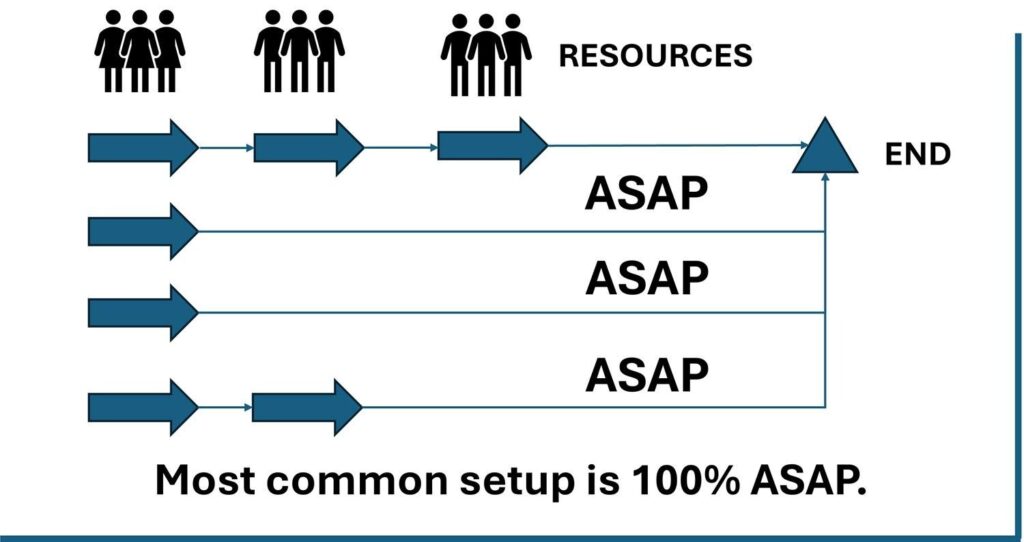
In an ASAP chain, every task begins at the earliest opportunity, pushing resources as far to the left as possible on the Gantt chart as illustrated in Figure 1.

Figure 1: As Soon As Possible Scheduling Option

ALAP – As Late As Possible

As late as possible:

  • Means tasks are scheduled as late as possible without delaying the successor or project finish date.
  • Is used in backward-scheduled projects (those planned from a fixed finish date) or when you want to defer work until the last responsible moment.
  • Microsoft Project automatically places each task at the latest feasible start date that still satisfies all constraints.

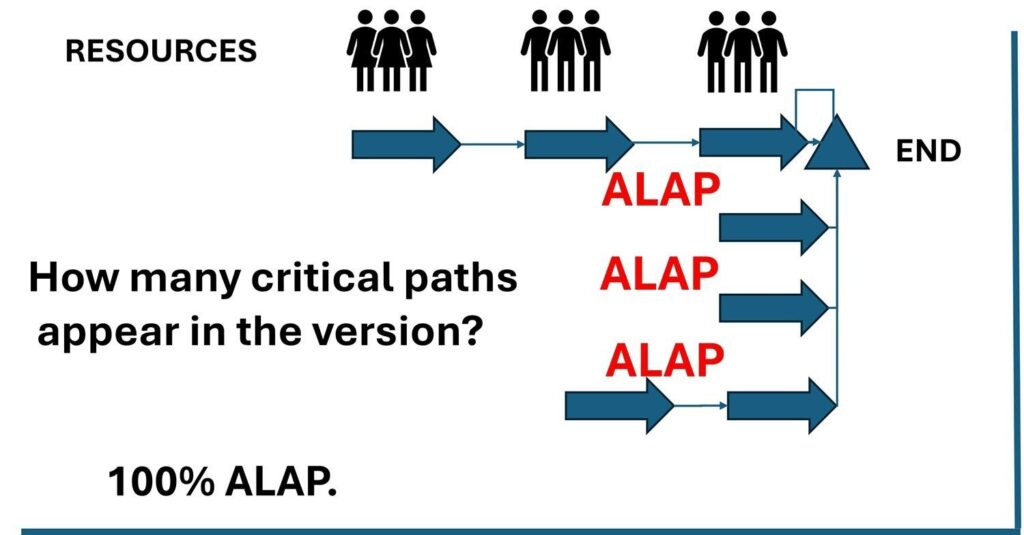
Switching a chain of tasks to 100% ALAP dramatically shifts all work to the right on the timeline as illustrated in Figure 2. The impact on management is significant: Every task now has zero total slack, which means any delay, even one day, directly delays the project finish. Multiple paths can appear “critical,” making control and reporting more complex.

Figure 2: As Late As Possible Scheduling Option

When ALAP Makes Sense

There are legitimate reasons to use ALAP selectively. For example:

  • When a task consumes resources you don’t want engaged early (e.g., expensive equipment rental or specialized consultants).
  • For just-in-time deliveries or procurements where early completion has no benefit.
  • When modeling backward scheduling. For instance, working from a fixed delivery date toward today.
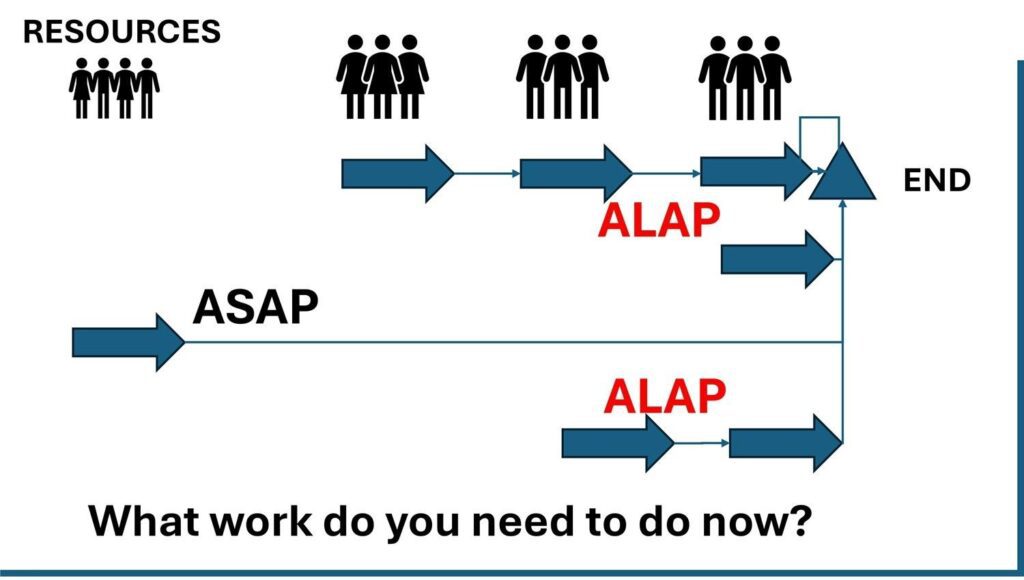
  • A mixed schedule. Mostly ASAP but with a few ALAP tasks can balance flexibility, cost control, and realism as illustrated in Figure 3.
Figure 3: A Schedule Using ALAP and ASAP

A Real-World Example

One of H&A’s senior scheduling consultants once faced this exact dilemma while helping to prepare a multi-year, multi-billion-dollar defense proposal for a project with strict annual funding limits. 

With less than two weeks before the submission deadline, the Proposal Director was exasperated: “I keep asking the engineers what can be delayed! Why does everything have to happen up front? The front-loaded schedule is blowing our funding cap!”

A quick inspection revealed the problem: every task was set to ASAP. The entire effort was jammed toward the beginning of the timeline, creating a massive early demand for resources. After several failed attempts to persuade the engineers to move work later, the consultant proposed something unconventional: “Let’s flip the question. Instead of asking what can we delay, let’s ask what must be done now.”

The H&A scheduling consultant converted the entire schedule to ALAP, instantly shifting all work to the far right of the timeline. The resulting view inverted the problem, from overspending early to under-spending, and gave the team a new way to discuss priorities.

In meetings, engineers were asked to move tasks from ALAP to ASAP one at a time, stopping when the annual funding limit was reached. The discussion changed from “Why can’t we do this now?” to “What can we afford to do this year?”

The result wasn’t elegant, but it solved the immediate problem: the funding limits were clearly observed, the resource profile became manageable, and the trade-offs were visible to everyone.

How ALAP Affects Critical Path and Risk

Because ALAP tasks consume all available float, they appear critical even when they may not truly drive the project finish. This can obscure the actual critical path, making it difficult for project managers to distinguish between genuine schedule risks and artificial ones. In Earned Value Management (EVM) environments, this matters. Earned value metrics depend on knowing which tasks drive completion. Excessive use of ALAP can lead to misleading forecasts and distort DCMA data quality metrics such as the Total Float test and the Critical Path test. For this reason, auditors often recommend using ALAP sparingly and documenting the rationale wherever it’s applied. 

Note: in a sophisticated scheduling environment, it is possible to make a copy of the integrated master schedule (IMS) and revert to ASAP to look for critical paths in the normal sense.  

Combining ALAP with Other Constraints

In practice, project managers often use a blend of constraint types. For example, you can combine ALAP with “Must Finish On” or “Start No Earlier Than” dates to simulate external dependencies such as contract milestones, funding release dates, or material delivery windows. This hybrid approach allows the schedule to model reality while maintaining logical control. However, it’s important to track these constraints carefully. Too many “hard” constraints of any type can reduce the schedule’s dynamic nature and make automated forecasting less accurate.

Guidance from Industry and Agencies

Industry and government scheduling guides consistently advise restraint when using ALAP. The DCMA data quality tests consider the presence of ALAP tasks as a potential red flag because they can mask schedule float and obscure the true drivers of program completion. Similarly, the GAO’s Schedule Assessment Guide recommends minimizing artificial constraints and using logic-driven sequencing whenever possible. ALAP may be appropriate for modeling constrained resources or fixed delivery milestones, but it should always be justified and documented. Within DoD and NASA programs, reviewers often require clear evidence that ALAP usage is intentional, controlled, and limited to well-understood modeling cases. It should never be used as a workaround for poor sequencing.

Key Takeaways

  • ASAP emphasizes early starts, clear float visibility, and traditional forward scheduling.
  • ALAP emphasizes delayed starts, tighter resource control, and is useful in backward or funding-constrained planning.
  • Use ALAP sparingly and intentionally as it can obscure float and create multiple critical paths.
  • In creative problem-solving, toggling between ASAP and ALAP can reveal insights about timing, funding, and necessity that might otherwise remain hidden.

Final Thoughts

The ALAP constraint is a powerful but double-edged tool. It can simplify discussions about funding limits, resource phasing, and timing priorities, but it also carries risk if used indiscriminately. Like most features in commercial off the shelf (COTS) scheduling tools, its value depends on the user’s intent and discipline. The best project schedules blend logic, transparency, and flexibility. Understanding when to use ALAP (and when not to) can make the difference between a reactive plan and a truly managed one.

Interested in Learning How to Use More Advanced Scheduling Techniques?

Master schedulers skilled at asking the right questions to solve project management challenges hone their craft based on years of experience and working with other scheduling experts. There are always opportunities to learn more. H&A routinely offers basic, advanced, and tailored scheduling workshops taught by senior master schedulers with decades of experience in all types of project environments using common scheduling tools such as Microsoft Project and Oracle Primavera P6. Give us a call today to get started. 

Humphreys and Associates also offers basic and advanced EVMS training as well as tailored EVMS training that aligns with a client’s EVM System Description. 

Understanding the As Late As Possible (ALAP) Scheduling Option in Practical Terms Read Post »

Maximizing the Value from Integrated Baseline Review (IBR) Investments 

, , , , , , , ,

A previous blog, How Integrated Baseline Reviews (IBRs) Contribute to Project Success, provided an overview of the purpose and scope of IBRs as well as the benefits of conducting an IBR. This blog adds to the discussion on the benefits of conducting an IBR. It reflects observations gathered from our earned value consultants while assisting clients to prepare for IBR events

As a reminder, IBRs provide the opportunity to verify the:

  • Contractor and the customer have a common understanding of the scope of work, technical requirements, and accomplishment criteria. 
  • Contractor has established an executable performance measurement baseline (PMB) for the entire contractual scope of work that accurately reflects how they plan to accomplish the work within the contractual period of performance, negotiated contract cost, and funding profile. 
  • Required resources have been identified and assigned to the project to accomplish the project’s objectives. For example, the staffing plan accurately reflects the sequence of work as well as resource availability and demand.  
  • Technical, schedule, and cost risks/opportunities have been identified, assessed, and captured in a risk/opportunity register. Risk mitigation actions have been incorporated into the PMB to reduce known threats to an acceptable level. This is often the most valuable component of the IBR to ensure all parties have an understanding of the risks/opportunities, assumptions, and risk mitigation or opportunity capture plans. 

Factors that Contribute to a Successful IBR

Treating an IBR as just a contractual requirement limits its value to all parties. IBRs are essential to the successful execution of any project. IBRs require a focused mindset to clearly define as well as assess the measurable benefits gained for the time and effort invested in the IBR. From our observations, contractors that defined what they expected to gain from an IBR, whether the IBR was contractually required or not, made a measurable difference in the outcomes from the IBR. The effectiveness of an IBR is contingent upon management’s commitment to excellence in implementing their EVMS and their desire to ensure they have reliable and useful data for management visibility and control. And that begins with establishing an executable PMB. 

The following list of factors often influence the perceived value of an IBR and hence the approach a contractor takes to planning and conducting their IBRs. 

  • Recognizing the relative importance of the review.
  • Defining the value or measurable benefits they expect to gain from conducting the review.
  • Well defined risk/opportunity management process. 
  • Timely and sufficient review planning and preparation.
  • Joint or collaborative planning and preparation.
  • Well defined objectives as well as entrance and exit criteria. 
  • Tailoring the IBR approach to best accomplish the review objectives.
  • Communication and expectation management.

These factors were ultimately indicative of whether the IBRs were considered value-added (retrospective assessment by the participants) based on the level of understanding, investment in or attention to, or the degree of success in implementing these factors. Based on H&A earned value consultant’s observations, the single factor that tends to drive the IBR approach is clearly defining the value the contractor expects to gain beyond what is mandatory or contractually required. 

IBR Investment Value

The term “IBR investment value” is purposefully used here. The intent is to invite you to re-assess how IBRs are viewed apart from simply meeting government agency IBR requirements. “IBR investment value” is used to mean a qualitative assessment that encapsulates the value-add or measurable benefits teams often have difficulty defining as well as to help provide the impetus and guiding direction for conducting an IBR. It has both intrinsic and extrinsic properties. 

The intrinsic value of the IBR investment resides in those specific elements of information (as identified by the customer in the form of questions or concerns) that are either exchanged, clarified, or refined through the course of discussions between the customer and performing contractor teams. This intrinsic value can be measured by how well the exchanged information supports:

  • A complete, clear and mutual understanding of the work to be accomplished.
  • The resources needed to get the work done.
  • The detailed plan to perform the work.
  • What resources are available to support the plan.
  • What’s missing or unknown that is needed to complete the work correctly and on time.
  • What risks, issues, concerns, or opportunities are associated with contractor’s concept that need to be fully considered to make the plan work. 

The extrinsic value of the IBR Investment rests wholly in the quality of the exchanges (discussions), and the resulting actions generated from the discussions. This extrinsic IBR value addresses how appropriate, rich and comprehensive the information exchanges were, and answers to questions, such as:

  • Were the discussions responsive to a list of customer information requirements and concerns? 
  • Were the right discussions held? At the right level of detail?
  • Were the right people involved in each discussion? 
  • Did the discussions provide sufficient context? Were they comprehensive? Complete?
  • Did the discussions address associated risks, issues, opportunities or other concerns? Relationships to other discussions/elements?
  • Were all the customer’s questions or concerns answered to their satisfaction?
  • Were the discussions documented to support decisions? Alternatives? Changes? Studies?

The exchanges of essential information (intrinsic value) and the quality of those exchanges (extrinsic value) when combined directly translate to the investment value achieved from the IBR. It characterizes how well the information exchanged provides both teams with the necessary details to successfully define, schedule, budget, and manage the contracted effort relative to the investment into the IBR process. A realistic, risk adjusted PMB helps to prevent schedule delays and cost overruns during project execution that often impact a contractor’s profit margins and tarnishes their credibility with their customers. 

What are the characteristics of a value added IBR approach?  

A successful approach H&A earned value consultants have observed contractors implement is a structured process corporate management actively participates in to ensure they gain the most value from all IBR events. 

This is often an outgrowth from corporate initiatives to retain top project management talent and establishing an EVMS self-governance process. It is part of a corporate culture that is committed to excellence in project management and sustaining a best in class EVMS – becoming efficiently expert at EVM

What are some common characteristics of their IBR approach?

  • A chartered authority or corporate team responsible for assisting project personnel with IBR events in addition to EVMS implementation, self governance, and customer surveillance events. A good practice we have seen implemented is to establish rotating members on the IBR teams from different projects as a means to pollinate best practices across projects. It also provides an opportunity to mentor top talent on track to move up to higher management positions.  
  • A standard repeatable process with defined measurable outcomes that can be tailored to the unique project requirements or objectives. This includes maintaining a set of materials for the internal IBR team to effectively plan and execute an IBR as well as to close out any action items. Examples include training materials to prepare project personnel, process description with team member roles and responsibility assignments, data call list, role based interview question forms with assessment criteria, data quality assessment materials and tools, list of data traces to be performed, schedule risk assessment tools, risk/opportunity evaluation criteria, defined assessment criteria (technical, schedule, cost, resources), in-briefing and out-briefing templates, and template to capture action items to track to closure. The corporate team is often responsible for actively maintaining the content for the IBR teams and conducting training. 
  • They place an emphasis on two components that directly impact the quality of the schedule and cost data.  This includes:
    • Well-documented data driven basis of estimates (BOEs) that can be substantiated using historical or bench-marked data with the goal of reducing expert judgement cost estimates to the lowest level possible as a risk reduction strategy.  
    • The quality of the risk/opportunity management plan and the content in the risk/opportunity register. This content directly affects the ability of all parties to gain a better understanding of the risks/opportunities and best options to mitigate a risk or capture an opportunity. A well constructed schedule is required to be able to perform schedule risk assessments (SRAs). SRAs help to identify where duration risk exists in the schedule and to determine a level of confidence in meeting major project milestones as well as the project completion date.  
  • They perform internal IBRs as a standard practice on all projects regardless of contractual requirements. This is particularly important when subcontractors are performing a substantial percentage of the work effort. The corporate team often assists Project Managers with conducting a joint IBR with major subcontractors.  

Need help establishing a corporate IBR process?

H&A earned value consultants often help clients to establish a corporate EVM council or center of excellence with defined responsibilities to ensure project personnel effectively implement their EVMS, integrate risk/opportunity management into the EVMS, as well as define and implement a standard repeatable process for IBRs and self-governance. Clients often need assistance establishing a repeatable process for conducting schedule risk assessments, an essential component of the IBR process. A defined process that clearly articulates the expected measurable outcomes from conducting IBRs is one way to ensure all parties gain the most value from the event with the end objective of ensuring a realistic and executable PMB has been established.  

Call us today to get started.  

Maximizing the Value from Integrated Baseline Review (IBR) Investments  Read Post »

Who Should “Own” Earned Value Management (EVM)? Programs or Finance?

, , , , , ,
Who should own erarned value management?

I have read several Earned Value Management (EVM) reports, papers, and articles that debate what company organization should “own” EVM and the company’s Earned Value Management System (EVMS). These debates most often mention the finance department and program organization as common EVM “owners.” The majority opinion seems to be that because EVM is a program management best practice it belongs in the program organization. A minority opinion is that because EVM is denominated in dollars, schedule included, and because EVM reports are financial in nature, EVM belongs in the finance department. Before we dive into this debate, a summary of the responsibilities of a Chief Financial Officer (CFO) and the head of programs is useful. In the Company A and Company B examples to follow, both the CFO and the head of programs reported to the company president.

What are the duties of a Chief Financial Officer (CFO)? 

A CFO has three duties; each measured in the time domain. The first duty of the CFO is as the company’s controller and is responsible to accurately and honestly report past company financial performance. The CFO is also responsible for the current financial health of the company – to ensure that today’s decisions create rather than destroy value. And lastly, the CFO must protect the company’s future financial health and that all expenditures of capital maximize that future financial health. Every business decision, especially those of the CFO, are either good decisions (are accretive – increase shareowner value) or are bad decisions (are dilutive – destroys shareowner value).

What are the duties of the Head of Programs?

The head of programs is typically a Vice President or higher and all program and project managers report to them. The head of all programs has profit and loss responsibility for their portfolio of programs and projects. In addition, each program and project manager is responsible for achieving the technical, schedule, and cost requirements of the contracts they are executing on behalf of the company’s customers. 

A Tale of Two Companies

I have first-hand experience with two companies and how each company decided who should “own” EVM that illustrates the nuances to these two approaches. 

Company “A” had EVM assigned to the finance department. All EVM employees were overhead, even those assigned to a program. A new CFO arrived and quickly decided to reduce indirect costs, declaring that he was “coin-operated.” The new CFO terminated the employment of all EVM employees. Each program attempted to create an EVM branch office but failed. DCMA issued a Level 3 Corrective Action Request (CAR) detailing the EVMS deficiencies and the CFO was fired. A second new CFO arrived and agreed to transfer EVM to the head of programs. The head of programs was instrumental in changing the disclosure statement making EVM personnel assigned to a program a direct charge to that program or contract. The head of programs created a Program Planning and Control (PP&C) organization and demanded all Program Managers and their program members to quickly learn, use, and master EVM. A program control room was built with five screens. Daily 2 pm EVM data-driven reviews were held on short notice. These daily reviews became known as “CAM Bakes.” The EVM and program management culture changed quickly and dramatically at Company “A.”

Company “B” had EVM assigned to the CFO who was as “coin-operated” and unaware of EVM as was the first new CFO of Company “A.” The culture of company “B” was very hostile to EVM, so it probably did not matter who “owned” EVM. The company failed 16 of the EIA-748 Standard for EVMS 32 guideline requirements and they lost their DCMA approved EVMS status. Significant withholdings were imposed and the company’s reputation was damaged. Several top managers hostile to EVM sought employment elsewhere. A new CFO arrived who was also coin-operated – with one difference – the CFO was an expert in EVM. The new CFO formed a partnership with the head of programs. The new CFO was as much a program manager as he was a CFO. The new CFO told his direct reports assigned to each program to “make the program managers successful.” And they did exactly that. 

The new CFO understood that the company was the sum of all its contracts and that every dollar flowed from its customers. The EVM and program management culture at Company “B” changed rapidly.

Who Should “Own” EVM? Programs or Finance?

Returning to our original question of who should “own” EVM, the majority theory is that the program organization should “own” EVM. All else being equal, I tend to agree with this theory. 

However, while theory is suggestive, experience is conclusive. My experience at Company “A” proved that a strong program leader could rapidly change the EVM and program management culture of a company. My experience at Company “B” proved that a CFO could “own” EVM and be successful at changing the company’s EVM and program management culture. The CFO and the head of programs must form an EVM partnership no matter who “owns” EVM. 

Who “owns” EVM at your company? 

Mr. Kenney is a senior business executive with over 35 years of experience in the aerospace industry as well as over 10 years as a consultant to industry. He is an experienced practitioner of program management best practices as an Executive Vice President of Government Programs, Vice President of Naval Programs, and Program Manager at various aerospace and defense contractors. He is also a retired U.S. Marine Corps Colonel with 27 years of active and reserve duty. 

Who Should “Own” Earned Value Management (EVM)? Programs or Finance? Read Post »

Scroll to Top